
HF Interferometry Method
The method identifies coherent TID activity at different sites and sets bounds to time intervals for which such activity occurs into a given region. A TID related disturbance modelling is applied to isolated TID candidate effects on ionospheric variations. TID characterization is obtained by applying spectral analysis methods, allowing to estimate dominant oscillation activity period. Using interferometry methods to multi-site records, the 2D TID vector velocity is estimated. This allows for identification and tracking of TID activity from Digisonde Networks.
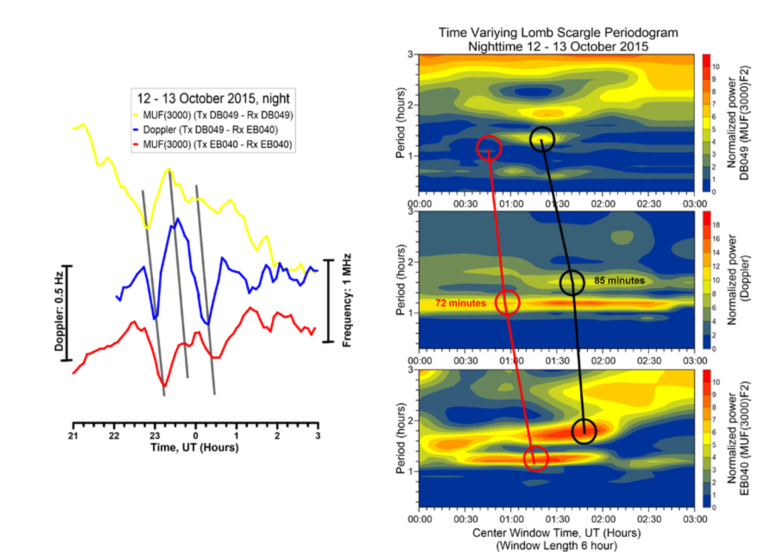
On the left: MUF(3000)F2 variations at Roquetes (red) and Dourbes (yellow), blue curve is the Doppler frequency measured at the Dourbes-to-Roquetes D2D link; On the right: Corresponding periodograms.
Due to the geographical distribution of Digisonde sites within European and South African networks (distant by about 1000 km from to each other), only identification of large scale TIDs (LSTID) is feasible in principle, which are associated with auroral and geomagnetic activity, directly related to Space Weather. Finally, near real-time implementation of the method to identify and track TID activity from classical ionospheric characteristics measured with Digisondes in the European and South African Digisonde Networks will be developed into an operational tool under the proposed project.
Altadill, D., E. Blanch, V. Paznukhov, et al, Identification of travelling ionospheric disturbances applying interferometry analysis to classical ionogram data from an ionosonde network, IEEE-TGARS, 2017 (submitted)