
HTI Technique to Monitor Wave Activity
The height-time-reflection intensity (HTI) methodology is similar to the technique producing range-time intensity (RTI) radar displays within a given time interval. The application of this method in the frames of the project will enable the identification and tracking of the TID activity over each Digisonde station by using the actual ionograms produced over each station. This technique considers an ionogram as a ‘‘snapshot’’ of reflected intensity as a function of height and Digisonde signal frequency, and uses a sequence of ionograms to compute an average HTI plot, (for a given frequency bin) that is essentially a 3-D plot of reflected signal-to-noise ratio in dB as a function of height within a given time interval; this display, which can be either color- or shade-coded, reveals dynamic changes in the ionosphere. Typical output of the Nicosia Digisonde HTI software is presented in figure below, demonstrating TID-like variations, for 7 March 2016. It corresponds to a Digisonde frequency band, of 1.5–3.0 MHz. By considering the points of strongest signal reflection (indicated by black dots in the figure) spectral analysis will be performed to infer the periodicity of the dominant wave activity over each Digisonde station.
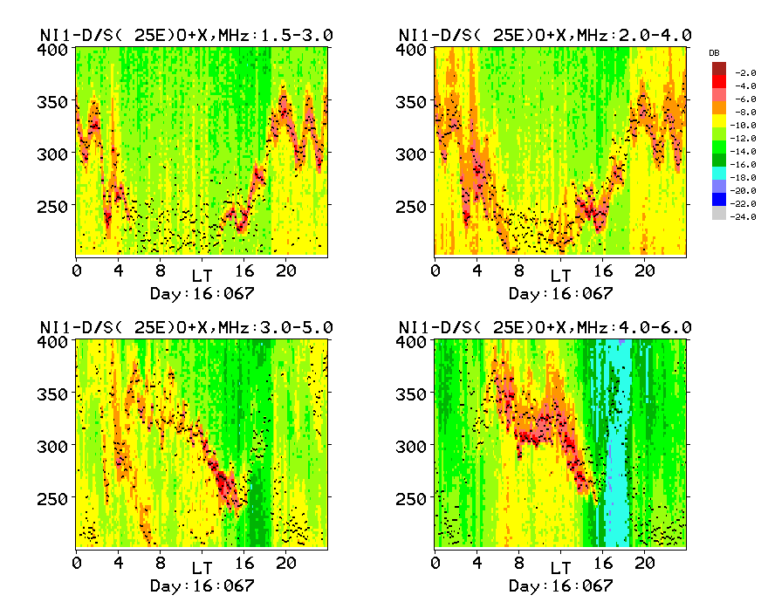
Digisonde HTI plot over Nicosia on March 7, 2016.
Haldoupis, C., Meek, C., Christakis, N., Pancheva, D., Bourdillon, A., 2006.Ionogram height–time–intensity observations of descending sporadic E layers at mid- latitude. Journal of Atmospheric and Solar Terrestrial Physics 68, 539–557.