
The AATR Indicator
In the context of ESA founded ICASES project, the Research group of Astronomy and Geomatics (gAGE/UPC) defined the Along Track TEC Rate (AATR) index (Sanz et al., 2014). This index has been used to identify the conditions where a degradation in the user performance of the SBAS systems in general, and in EGNOS in particular, is expected.
As an example, the figure below shows the relationship between the AATR index and the EGNOS APV1 availability over a period of two years for a station in Canary Islands (MAS1). These results are after the EGNOS v2.3.1 upgrade (from May 25th 2012 to August 15th 2014). As it can be seen, high values of this index lead to worse performances in the EGNOS APV1 availability due to the ionospheric conditions.
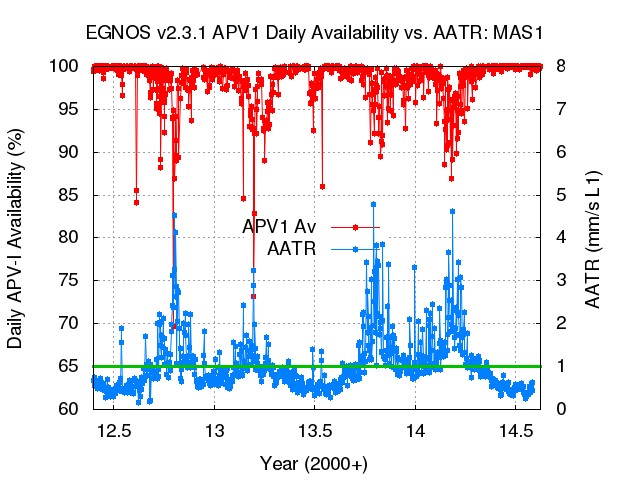
Relationship between the daily EGNOS APV1 availability (in red colour) and the daily maximum values of AATR (in blue colour). The horizontal green line indicates an experimental threshold for AATR of 1 mm/s of L1 delay.
The AATR index has been chosen as the metric to characterize the ionosphere operational conditions in the frame of EGNOS activities. This indicator has been also proposed for joint analysis in the International SBAS-Ionosphere Working Group.
Sanz, J., J. M. Juan Zarnoza and G. González-Casado, et al. Novel Ionospheric Activity Indicator Specifically Tailored for GNSS Users. Proc. 27th International Technical Meeting of The ION GNSS+ 2014, Florida, September 8-12, 2014.